

A bit of history—or rather, a great deal of it!
The church

It features a graceful Lombard-style bell tower with two tiers of twin arched windows separated by a small column. The frescoes date back to the second half of the 15th century. The building comprises a nave and an apse with a semi-dome (cul-de-four) vault, a later side aisle, and a bell tower topped with a spire. The structure is built entirely of local rubble stone. Only the small columns of the bell tower windows and the semicircular arches above them are made of marble. Inside, the walls and vaults are covered with 15th-century frescoes. A Gallo-Roman funerary stele (cippus) is embedded in the side wall, above the entrance door.
Bertrand Bernard was a history painter and decorator who contributed to the decoration of several churches in the Luchon area and the Chambert thermal baths during the second half of the 19th century. He was a member of the French Archaeological Society. He died in 1902.

Did you know ?
The frescoes

The 15th-century frescoes are attributed to three different painters of unknown origin. The apse and the lower sections had been whitewashed—likely in the 17th century—and were rediscovered in 1873 by Bertrand Bernard, a painter from Luchon. Some were restored, but the finest examples remain untouched... It is these latter ones that are currently deteriorating and require urgent "treatment," employing the delicate modern techniques mastered by specialists in the restoration of artworks—and frescoes in particular. The Cazeaux paintings were executed *a fresco*, meaning they were applied directly onto fresh lime plaster.
Did you know ?
*A fresco* is a specific painting technique applied to plaster while it is still fresh—traditionally air-slaked lime. When colored pigments are applied to the plaster layer, a chemical reaction traps them within crystals that bind them to the surface, ensuring their longevity.
Iconographic breakdown:
In brief
Upon entering the church, one is struck by the scale of the imagery: the vault and all the walls are painted. Featured scenes include a magnificent depiction of the Last Judgment, Adam and Eve in the Garden of Eden before their expulsion from Paradise, the Coronation and Assumption of the Virgin, the Nativity, the Passion of Christ, and more.
Glossary
Apse: The rounded end of the church—usually facing east—located behind the altar at the far end of the chancel or *chevet*.
Twin windows (*baies géminées*): Openings separated by a column.
Cul-de-four: A semi-domed vault covering the apse.
Fresco: A wall painting executed on fresh plaster (*a fresco*), causing the pigments to become incorporated into the plaster itself. Wall paintings created later on dry mortar (*a secco*) are often mistakenly referred to as "frescoes." Leviathan: a monster with a wide-open maw symbolizing Hell.
Monolith: composed of... ...carved from a single stone.
Pantocrator: Christ in Majesty, often depicted enthroned within a mandorla—an almond-shaped or oval halo.
Phylacteries: Scrolls of parchment held by a figure or emerging from an instrument, bearing the spoken words; the equivalent of a comic book speech bubble.
Tetramorph: A representation of the four Evangelists symbolized by their emblems: Luke with the ox, Mark with the lion, John with the eagle, and Matthew with the angel or a human figure.
The Last Judgment

Christ in Majesty, seated on his heavenly throne and clad in a red tunic—symbolizing his divinity—extends his arms and opens his hands to reveal his stigmata, while his parted tunic exposes the wound in his right side. On the left side of the lower register, the Virgin Mary is distinguished by a rare and precious gesture: she presses her breast, spraying three jets of milk onto her Son's wounds.

Here is the Archangel Michael with the scales used to weigh the souls of the dead as they rise from their tombs. Demons are cheating: one clings to the scale pan, while another presses down on the balance beam to tip the scale toward Hell and the gaping maw of Leviathan—a monster representing the underworld, also found in the church of Jezeau (Hautes-Pyrénées).
Adam and Eve in the Garden of Eden

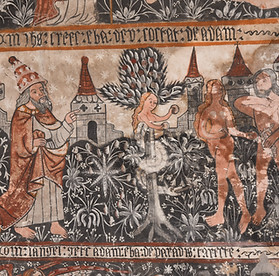
On the second bay, along the south side, the story of Adam and Eve is told in three scenes: The first shows God the Father, wearing the papal tiara, creating Eve as she emerges from the side of the sleeping Adam.

In the second scene, Adam and Eve are in the Garden of Eden, tempted by a demon that has taken the form of a serpent with a woman's body. They succumb to temptation.

They are driven from Paradise by an angel armed with a sword. The scene bears the following caption: *COM LANGEL GETE ADAM EBA DE PARADIS TARESTE* (How the angel drives Adam and Eve from Paradise).
The Assumption

The Virgin Mary is borne aloft by four angels; two cherubs carry her crown, while four musical angels accompany her ascent to heaven with her earthly body.

Flanking this scene are eleven figures: six on the left (only one of whom lacks a halo and wears a hat instead; with his left hand, he points to the purse held in his right: this is Judas). The scrolls they hold bear praises to the Virgin (*belut rosa, flos virginum, ave regina caelorum*... Wild rose, flower of the Virgin, Hail Queen of Heaven...)

...and five on the right. These are clearly the apostles who, according to the apocryphal gospels, were present at the Assumption of the Virgin. But who is the missing twelfth figure? This question remained a mystery for a long time. In fact, it is Saint Thomas, according to the *Golden Legend* by Jacobus de Voragine (c. 1228–1298), who also writes: "...Peter and Paul lifted the coffin, and Peter intoned: *Exiit Israel de Aegypto, alleluia!*" This is precisely the text inscribed on the scrolls held by the five apostles on the right.
Colors, pigments, and symbolism
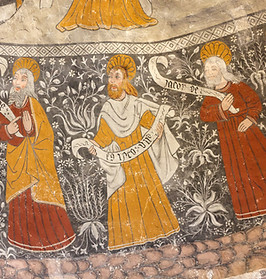
Ochres

Ochres
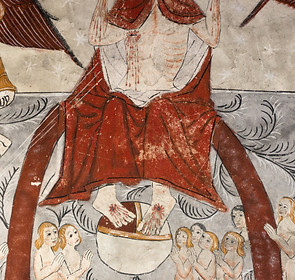
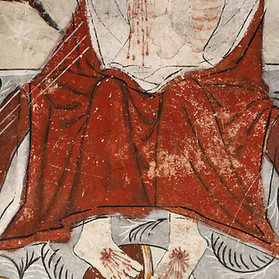
Reds
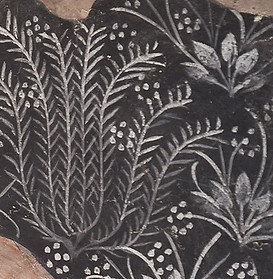
Bertrand Bernard (cited by Abbé Lancontrade): "These paintings were executed using a lime base on fresh mortar—surfaces that were sometimes smooth, sometimes quite rough. The style is rather bold; the drawing appears to have been done in a single pass with the tip of the brush, using lines that are generally black. We observed few signs of alteration or correction..."
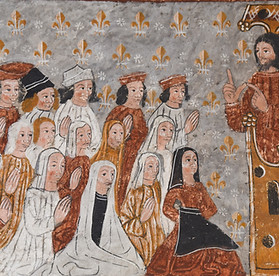
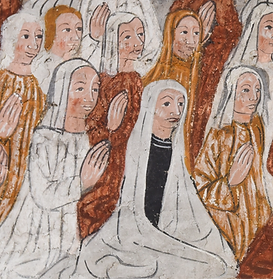
The pigments used in the frescoes of the Church of Sainte-Anne are, on the face of it, simple: ochre, black, and white. No blue or green. One question remains: a bright red that might not be an ochre.
Generally speaking, for this type of work, the paint is prepared using natural pigments such as metal oxides or earths (Sienna earth, Roussillon ochres). Natural pigments are prepared by crushing crystals and mixing them with limewater. Natural pigments can be of plant, animal, or mineral origin.
Blacks
Blacks
Blacks
Whites
-
Red symbolizes both royal majesty and the sacrifice of Christ, evoking the blood of martyrs.
-
Black relates to moments of mourning or penance, such as Lent, but can also highlight the sacred.
-
White symbolizes purity; it is associated with angels and virgins.
-
Yellow is dual in nature, just like red. It is associated with light and wealth, yet in certain depictions, it also becomes the color of betrayal and exclusion.